


Forms of therapy and group activity
Actions may not always lead to happiness,
but there is no happiness without action.
— William James
Reinvent yourself in a safe environment
Everyone experiences moments of vulnerability when you need someone who sees you, listens to you, and supports you. At Raja Psychologie, we offer a safe environment where you can experience and develop yourself in new ways.
Change is a process in which we explore together how you think, feel, and act. That’s why we combine conversations with different forms of therapy, so that the process aligns as closely as possible with your needs.
An important goal is to (re)discover your potential, where you can consciously challenge yourself by stepping into sometimes uncomfortable but safe situations. This helps you connect more deeply with yourself, your feelings, and your body.
Sometimes words are not enough or are hard to find. Different therapeutic approaches can help you express and process your feelings in a safe way.
At Raja Psychologie, we believe in the power of togetherness. That’s why, in addition to individual therapy, we also offer group sessions. In group sessions, you meet others who are also working on their personal process. You learn from each other, recognize yourself in others, and discover new insights that you might not see on your own.
Our groups take place in a safe, respectful, and guided setting. They are small in size, so there is space for everyone’s story. Whether you need depth, emotional processing, more body awareness, or creative expression — we offer various forms of guidance that can match your needs.
Do you have any questions or want to sign up for a group? Email us at info@rajapsychologie.nl
, send a message, or contact your therapist.
Upcoming
March/April program in progress...
Individual Therapy

Body-oriented Therapy - Listening to what your body is telling you
- with Heidi
Your body always lives in the here and now, but it also carries the traces of the past. Experiences and emotions leave their mark, even when you are no longer consciously aware of them. Because body and mind are inextricably connected, the body is often where old pain or unresolved experiences manifest.
Our body is resilient: it can carry, process, and heal. But when this capacity is exceeded, it sends signals — for example, in the form of tension, fatigue, pain, restlessness, or emotional blockages. If we ignore these signals, they can become trapped and eventually lead to physical or psychological complaints.
Body-oriented therapy invites you to pause and relearn how to listen to what your body is trying to tell you. Together with Heidi, you’ll explore the meaning behind these signals. You’ll look deeper into what’s going on inside you, beyond words.
In this form of therapy, not only are your thoughts and feelings explored, but also body tension, breathing, posture, movement, and non-verbal expression. Through breathwork, gentle touch, movement, visualization, or expressive exercises, you will reconnect with your body and learn to recognize the underlying emotions or patterns.
Body-oriented therapy is often helpful for people who struggle to talk about their feelings, or those who tend to be overly intellectual. Since the body responds honestly and directly, you reach the core more quickly. Understanding doesn’t come through analysis, but through experience and awareness.
This deeper connection with yourself creates space for healing, relaxation, and personal growth.

Emotion-oriented Therapy - Learning to feel
- with Shira
From a young age, we are fed with knowledge and information that is meant to help us understand the world. We learn to calculate, reason, and perform. But when it comes to feeling and recognizing emotions, we often assume that this should come naturally. Yet, this is far from the case. Emotional skills also require practice, attention, and development.
Emotional intelligence is the ability to cope with the challenges of everyday life with patience, insight, and self-awareness. It plays a central role in your relationships with others as well as in the relationship with yourself. How well can you empathize with the feelings of another? And how do you deal with your own anger, fear, insecurity, or jealousy?
In the sessions, you will learn to better understand and recognize your emotions. You’ll discover how allowing and feeling your emotions can make your life richer and more balanced. By not pushing your emotions away but making space for them, you create more peace, self-knowledge, and connection — both with yourself and with those around you.
You will receive practical tools to deal with your emotions in a healthier way, without judgment. Not from a place of control or analysis, but from openness and gentleness.
Because those who learn to feel, also learn to live better.
Group therapy 2025

Art Therapy - Making the invisible visible
- with Agnes
Sometimes words fall short. You know something is alive within you, but it’s difficult to express or even recognize. Art therapy offers a calm, safe, and non-verbal way to give expression to what is deeply felt inside.
Through drawing, painting, or sculpting, you give shape to your feelings and thoughts. What is the color of your fear? What does sadness look like? By making your inner world visible through images, space is created to feel, understand, and let go. Colors, shapes, and symbols help you reconnect with what you may have hidden away for a long time.
Art therapy provides the freedom to tell your story in your own way. Without judgment, without pressure to perform. In the silence of the creative process, a safe space is created where emotions are allowed to flow, and what lives within you becomes literally tangible. You can see it, touch it, and approach it again — in a way that is healing.
The materials you work with — such as paint, clay, or chalk — can help release tension, express anger, or find strength. This form of therapy activates your self-healing ability and promotes balance between body and mind.
For every person carries, consciously or unconsciously, the art of becoming better within themselves.
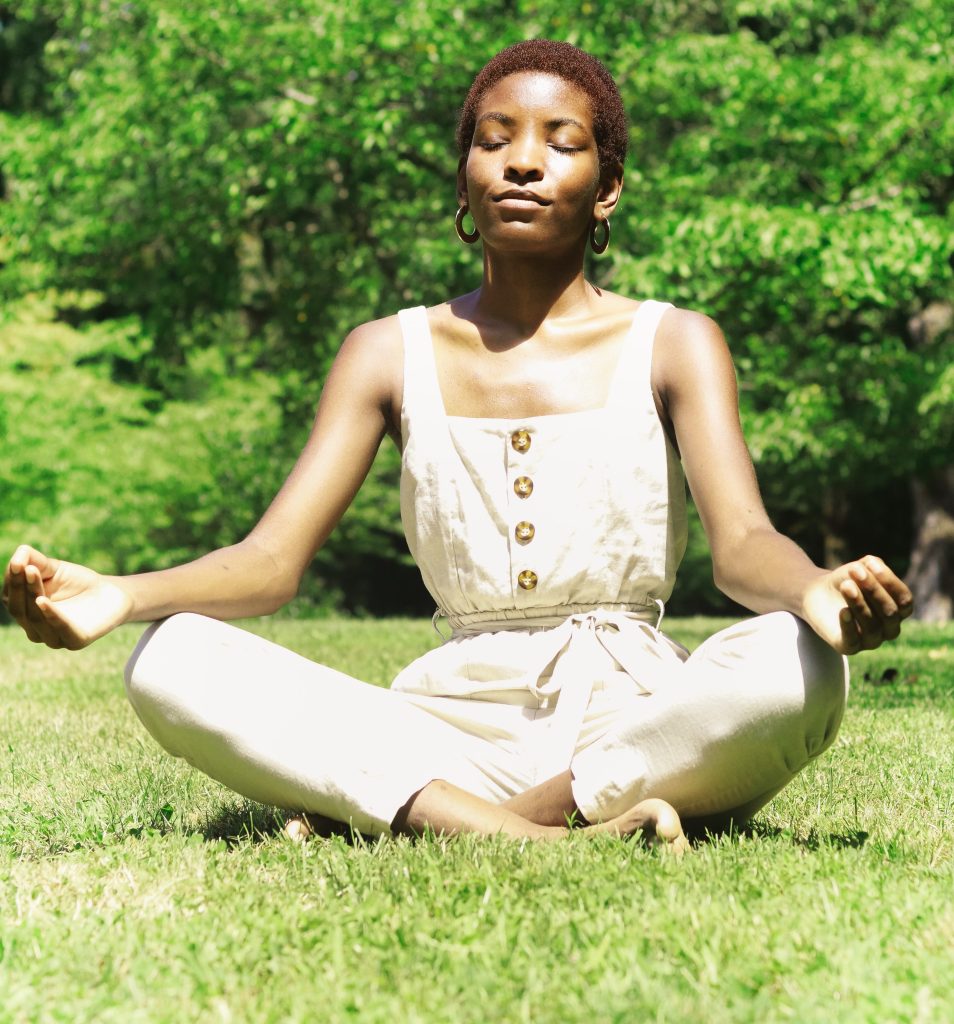
Yoga Therapy
- with Shira
The therapy takes place in the Reflection Room of our practice and is supervised by our dear colleague Shira. Gaining new experiences can help you get to know yourself better and can be a huge help to work on a fundamental change and improvement within your treatment path at our practice.
Yoga means connection. It is about connecting body, breath and mind. It is all about breath! By concentrating on the breath and posture, a meditative attention is created that leads to a better connection with yourself. Connection with yourself and your body is key to connecting with other people in everyday life.
It is a small group in which people treat each other with respect and acceptance in an environment where you can feel safe and familiar. Your individual needs, concerns and tensions are taken into account. This makes this form of therapy suitable for everyone.
group therapy (ca. 90 min)

group therapy (ca. 90 min)
Mindfulness & Meditation
- with Shira
“We are human beings, not human doers.”
Do you often think about something other than what you are doing at that moment? Living “in-the-moment”, how do we do that or how are we there? What does it mean to focus on being rather than doing in an era where productivity is rewarded? What does it mean to lead a purposeful, reflective life? And how does mindfulness have anything to do with it?
Mindfulness almost sounds like magic medicine. You can benefit from it in many ways. It can help with sleep problems, weight loss, symptoms of depression or anxiety, impulsiveness, self-esteem, attention and concentration, empathy and compassion, and overall physical health and mental well-being.
Mindfulness was developed by John Kabat-Zinn, a trained Dharma teacher (Dharma means suffering and refers to the teachings of the Buddha).
Deliberately paying attention to the present moment during various exercises and techniques, without judging it or having to change anything immediately. Being aware of what your senses are telling you right now.
As you learn to pay attention to your thoughts, feelings, and sense perceptions without judging them as good or bad, you will discover new degrees of freedom and learn how to handle stress better.
While these may be by-products of mindfulness, at its core, mindfulness is never about stress reduction, increased productivity, or better quality of life.
The word mindfulness is a translation of the original word ‘sati’, where the literal meaning is ‘memory’. Another word for it is ‘remember’. Yes, it’s about attention, but it’s more than just attention. Paying attention to our thoughts also promotes awareness of the person we try to be, the values we live by, and the kind of ethical or moral lifestyle we want to lead.
group therapy (ca. 90 min)
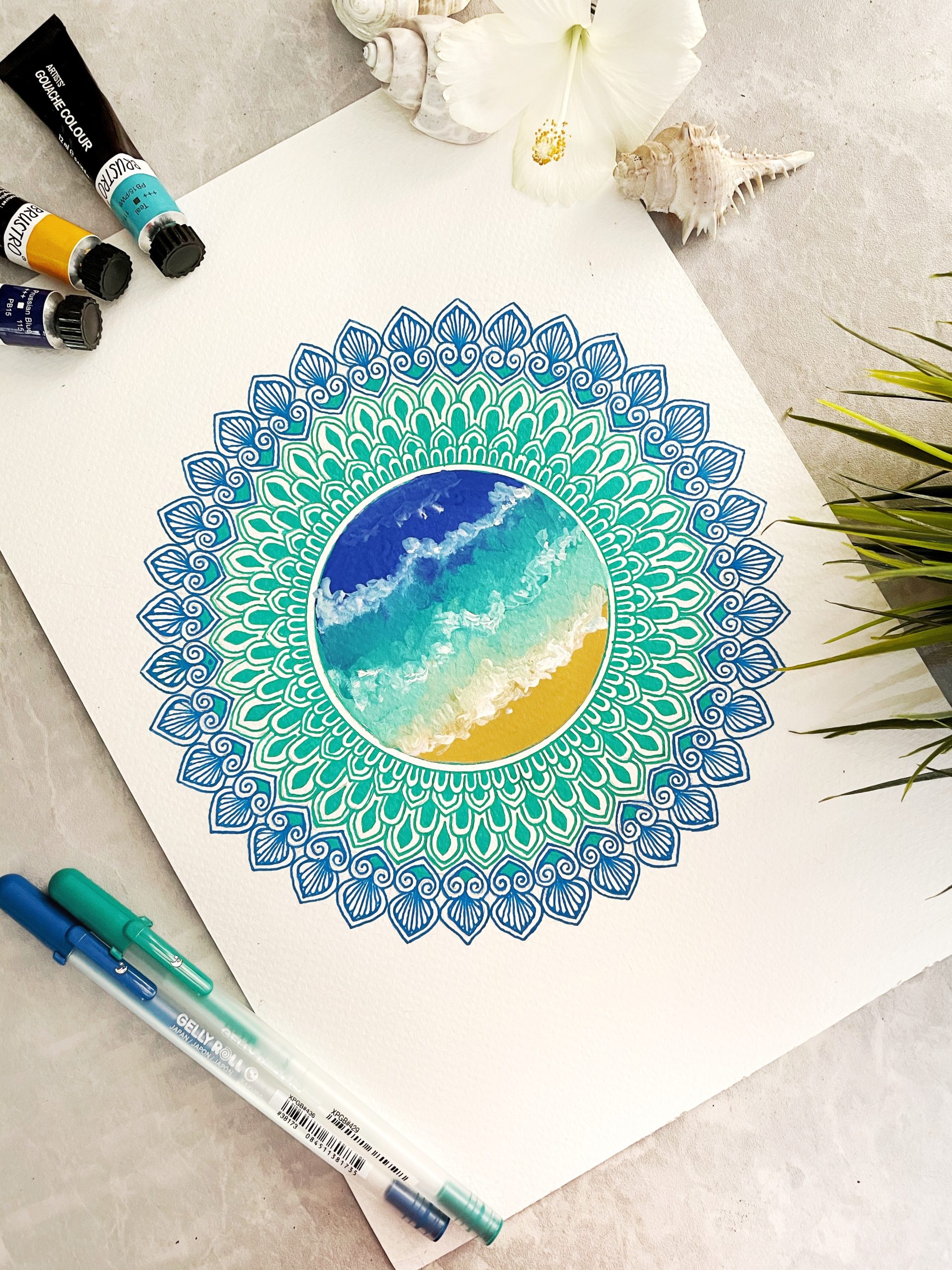
Mandala
- with Shira
A mandala is a circle, the word comes from Sanskrit and means (magical) circle.
You can work with geometric patterns by dividing the circle into even areas. You can make that pattern as complicated as you want. Then you can color the surfaces according to your own choice, creating a completely unique pattern.
This way you focus your attention on what you are doing, creating peace and space in your head. You will be surprised by the patterns, shapes and colors that arise under your hands. Does a harmonic picture emerge and does it become one whole? What inspiration can you take from this?
Mandala drawing is not about performing or delivering a ‘beautiful drawing’. What is important is your experience while drawing. I myself experience the silence and space within myself and enjoy making it. It is very important to look at yourself and the drawing without judgement. Does your mandala reflect something of yourself? Does the pattern that emerges say something about you?
Of course you can also make mandalas by just drawing what comes to mind, from a theme or from a visualization. People almost automatically start using symbols.
Because you draw within a circle, you move continuously between the center and the outer edge. You go in and out and back all the time. As a result, you are also sucked in yourself, as it were. The mandala becomes a drawing from within that is about yourself: you discover your creativity and your own symbolism.
“The mandala acts as a representation of the unconscious self” – Psychologist Carl Gustav Jung
Together we will use the mandalas as a means of creativity, inner deepening and personal development.

Walking therapy "Step by Step"
- with
Research has shown that people have fewer physical and emotional complaints through contact with nature. They suffer less from depression and anxiety.
Nature also has a healing effect on the processing of unpleasant events such as grief and loss. People who spend more time in nature recover faster from stress and concentration problems. People also feel less lonely and are sick less often.
During walking therapy, in addition to the usual therapy techniques (such as CBT, narrative, constellations, solution-oriented techniques and mindfulness exercises), we naturally use nature itself where possible! As far as we are concerned, nature is an inexhaustible source to work with.
group therapy (ca. 90 min)
Breathing
- with Shira
Anyone who has a busy job, is busy with the kids or just lives in the western world knows that stress is an important constant in your life. And how nice would it be if you could control this stress a little more easily? Sometimes it feels like we are stuck in certain patterns that seem to repeat themselves constantly. Breathing can help you through the emotion and tension.
In a stimulating, practical and, above all, light-hearted session, you will learn how to breathe properly and how to get more in touch with your body.

group therapy (ca. 90 min)
group therapy (ca. 90 min)
Mindfulness & Meditation
- with Shira
“We are human beings, not human doers.”
Do you often think about something other than what you are doing at that moment? Living “in-the-moment”, how do we do that or how are we there? What does it mean to focus on being rather than doing in an era where productivity is rewarded? What does it mean to lead a purposeful, reflective life? And how does mindfulness have anything to do with it?
Mindfulness almost sounds like magic medicine. You can benefit from it in many ways. It can help with sleep problems, weight loss, symptoms of depression or anxiety, impulsiveness, self-esteem, attention and concentration, empathy and compassion, and overall physical health and mental well-being.
Mindfulness was developed by John Kabat-Zinn, a trained Dharma teacher (Dharma means suffering and refers to the teachings of the Buddha).
Deliberately paying attention to the present moment during various exercises and techniques, without judging it or having to change anything immediately. Being aware of what your senses are telling you right now.
As you learn to pay attention to your thoughts, feelings, and sense perceptions without judging them as good or bad, you will discover new degrees of freedom and learn how to handle stress better.
While these may be by-products of mindfulness, at its core, mindfulness is never about stress reduction, increased productivity, or better quality of life.
The word mindfulness is a translation of the original word ‘sati’, where the literal meaning is ‘memory’. Another word for it is ‘remember’. Yes, it’s about attention, but it’s more than just attention. Paying attention to our thoughts also promotes awareness of the person we try to be, the values we live by, and the kind of ethical or moral lifestyle we want to lead.

groep therapy (ca. 90 min)
Creative therapy
'Getting light from darkness'
- with Agnes
During this session, the interplay between light, color and darkness plays a central role.
Light and darkness are invisible forces that become visible through the colors that appear in the atmosphere. You can think of a sunrise or sunset. In the interplay between light and darkness, a space is created in which movement emerges as color. You have to imagine that the light makes its way through the darkness. Because the darkness is attracted to the light, it comes from all sides, from all directions towards the light. Together we will look at how the forces of light, color and darkness work.
It will be a small group in which there is room to focus on yourself, but you can also enrich yourself through the experiences of others. In this way, insights arise from a different perspective. We work with a painting technique in which you can do nothing wrong, after all, the result is not the goal of the exercise, but the experience. Yet working with colors is also a relief for the eye and the heart. Experience with painting is not necessary.

group therapy (ca. 90 min)
Self-love & Self-acceptance
- with Shira
Self-love and self-acceptance both mean accepting yourself as you are, including your shortcomings. So you also accept – or rather: precisely – your imperfections.
A lack of self-love hinders you greatly in your goals, happiness and relationships. Life always mirrors the feelings we have within us back to us. Everything starts with – and depends on the degree of love you are for yourself.
Above all, love holds the power to heal. When you stop putting love at number 1 in your life, you die a little every day. All your pain comes from the belief that your source of love is outside of you.
Just check with yourself: do you accept yourself as you are? Do you currently have love for yourself? You may have had periods in your life when you couldn’t accept yourself as you were, and maybe you still do.
How can you love yourself more? How can you accept yourself as you are? During this session you will receive tips from our coach Shira to increase your self-love and self-acceptance… How do you do that? What is love anyway? In any case, it’s the one thing you’ll never lose. Start developing more self-love for yourself!
group therapy (ca. 90 min)
Self-expression
- with Shira
The existence-essence of every “being” in the universe, living or nonliving, is expression. Everything grows and blooms, you could say, thanks to this expression, be it a flower, a city or a person. Existence is, in a sense, synonymous with being expressive. Everything expresses itself, in any way. It is the expression of the Absolute itself, in manifest forms and movements. So it also applies to us humans. It is important to “express” ourselves in life in any way.
Human flourishing, in self-expression, is a very great good and should be the main goal in every human being’s life. Focused on flowering, we can also consciously/reflectively experience this because our human nature makes this possible. Other living creatures cannot. Without a certain amount of flourishing in our lives, we don’t really feel that we are coming into our own. Then life can even be experienced as meaningless.
One person uses canvas, paint and brushes, another designs sculptures or buildings, and yet another dances, sings, plays or composes music. Some write poems or books, some teach what inspires them or hold meetings, and still others start a family or design a business in order to prosper.
Anything can be art. Anything can be self-expression . Now you take the weapon and run with it. – Gerard Way
Emotions
- with Shira
We humans invest a lot of time and energy in becoming ‘smarter’. From an early age, we are fed with information and knowledge that should help us better understand the world around us. But when it comes to feeling something and understanding these feelings, we often think that it should all come naturally. That is not self-evident, because we also must learn emotional knowledge and skills!
Emotional intelligence is your ability to deal with the most important problems you encounter in your daily life with patience and insight. Both in your relationships with others, and in your relationship with yourself. To what extent do you understand what goes on under the surface of others and can you empathize with their point of view? And how well are you able to deal with anger, jealousy, fear and confusion?
In this sessions you will learn more about your emotions, how feeling and recognizing emotions can enrich your life and some tools to learn how to deal with them better.
group therapy (ca. 90 min)

Self-esteem
- with Shira
Low self-esteem & low self-worth have a big impact on our mental health. In this session you will learn how most of us find ourselves stuck in unhelpful cycles with anxiety, worry & our thoughts. We will introduce you to self-compassion (the opposite of self-criticism) and we will teach you how to identify and live to your own values. When you start to recognise your good qualities, strengths and talents and when you change the way you speak to yourself you can increase happiness, joy and peace in your life. Remove safety behaviours linked to low self-esteem…..because they have to go! This workshop will provide you with some effective tools to start to take back control.
At the end of the day this workshop can help you to improve your relationship with yourself and to manage everyday challenges so that you are ready to set life changing goals for the future!
group therapy (ca. 90 min)
Self-confidence
- with Shira
Self-confident people seem at ease with themselves and their lives. They invite trust and inspire confidence in others.
But it’s not always easy to be confident in yourself, particularly if you’re naturally self-critical or if other people put you down. Self-confidence is vital in almost every aspect of our lives, yet many people struggle to find it.
In this session you will learn how to increase and maintain your self-confidence.

group therapy (ca. 90 min)
Creative therapy
'Experiencing peace'
- with Agnes
In a time when a lot is asked of you at work, in your studies and in your social life, it is important to look for moments where you can relax and have peace for yourself. During this group therapy you will be helped to sink into your body and strengthen your inner peace through clear and simple exercises.
It will be a small group in which there will be space to focus on yourself, but you can also enrich yourself through the experiences of others. In this way, insights arise from a different perspective. The result is not the goal of the exercise, but the experience itself. Yet working with colors is also a relief for the eye and the heart. Experience with painting is not necessary.

group therapy (ca. 90 min)
group therapy (ca. 90 min)
Self-knowledge
- with Shira
Self-knowledge is the awareness of your feelings, traits, motivations, and abilities. As you learn and grow over the course of your life, your ability to know yourself and become aware of who you are is constantly changing.
While learning about yourself is an enlightening journey, it is not an easy journey for many. Our minds develop mechanisms to keep unpleasant or frightening thoughts and feelings out of our awareness. These mechanisms, such as intentional forgetting or unconscious suppression, can cause us to avoid the reflection needed to get to know ourselves better. This is because we have a stronger desire to maintain a certain internal image of ourselves than to learn who we really are. The end result is that we often lack self-knowledge and are unaware of its benefits in our personal and professional lives.
During this session you will get to know yourself better so that you can take better care of yourself and be better able to achieve your goals.
A score we are proud of

 Psychologenpraktijk Raja is gewaardeerd op ZorgkaartNederland. Bekijk alle waarderingen of plaats een waardering
Frequently Asked Questions
Treatment conversations with a psychologist offer you the opportunity to better see what you encounter and to discover how you can best deal with it. Your capacity for self-reflection is strengthened: what is wrong with me and what do I actually need?
There is a lot of variety in how we work together. Sometimes it is necessary, for example, to introduce a lot of structure in the sessions by sticking to fixed themes or exercises, and sometimes it is more appropriate to let go of the structure and the therapy mainly depends on your input. One is not necessarily better than the other. This depends on how you are put together, on the complaints you experience and on what you find important.
At our practice we are happy to help you to work on your goals!